Migration of Persian literati from Delhi to Awadh
Keywords:
Awadh, Persian literature, Nawabs, Mughals, Urdu, Lucknow SchoolAbstract
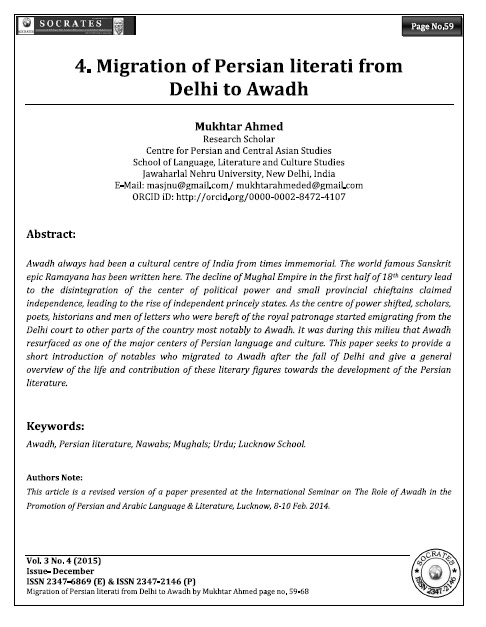
Awadh always had been a cultural centre of India from times immemorial. The world famous Sanskrit epic Ramayana has been written here. The decline of Mughal Empire in the first half of 18th century lead to the disintegration of the center of political power and small provincial chieftains claimed independence, leading to the rise of independent princely states. As the centre of power shifted, scholars, poets, historians and men of letters who were bereft of the royal patronage started emigrating from the Delhi court to other parts of the country most notably to Awadh. It was during this milieu that Awadh resurfaced as one of the major centers of Persian language and culture. This paper seeks to provide a short introduction of notables who migrated to Awadh after the fall of Delhi and give a general overview of the life and contribution of these literary figures towards the development of the Persian literature.
Downloads
Downloads
Published
Issue
Section
License
Revised Copyright/CC license that applies to all the articles published after 05-02-2017
Attribution-NonCommercial 4.0 International (CC BY-NC 4.0)

Copyright/CC license that applies to all the articles published before 05-02-2017
Attribution-Non Commercial-No Derivatives 4.0 International (CC BY-NC-ND 4.0)

Author(s) will retain all the right except commercial and re-publishing rights. In the case of re-publishing, they will have to obtain written permission from the journal. Additional licensing agreements (Creative Commons licenses) grants rights to readers to copy, distribute, display and perform the work as long as you give the original author(s) credit, they can not use the works for commercial purposes and are not allowed to alter, transform, or build upon the work. For any reuse or distribution, readers and users must make clear to others the license terms of this work. Any of these conditions can be waived if you get permission from the copyright holders. Nothing in this license impairs or restricts the authors’ rights. To view a copy of this license, visit http://creativecommons.org/licenses/by-nc-nd/4.0/ or send a letter to Creative Commons, 171 Second Street, Suite 300, San Francisco, California, 94105, USA.
Research Papers published in SOCRATES are licensed under an Attribution-NonCommercial-NoDerivatives 4.0 International (CC BY-NC-ND 4.0)