




About the Journal
SOCRATES: An International Refereed (Peer-Reviewed) and Indexed Scholarly Journal in Public Policy, Public Administration, and Philosophy.
Editor-in-Chief: Prof. (Dr.) Manoj Dixit, Vice-Chancellor, Maharaja Ganga Singh University, Bikaner, Rajasthan, India.
- ISSN Print: 2347-2146
- ISSN Online 2347-6869
- Frequency: Biannually (June and December)
- Language: English
- Broad Subject Category: Social Science
- Covered Subjects/Disciplines:
- Public Policy, and Public Administration
- Philosophy
Indexing: EBSCO, Crossref DOI, Google Scholar, OCLC WorldCat, BASE (Bielefeld Academic Search Engine) and many more.
The articles published in the Journal SOCRATES are preserved by LOCKSS and CLOCKSS.
Journal Coverage Includes:
- Research articles: Original research by author(s)
- Review articles: Significant reviews of original research
- Short communications: Brief research updates, news, views, and articles
- Case studies: Analytical findings of individual cases
- Research methods: Reports on new research methods
- Opinion papers: Articles presenting individual or group opinions
- Observations (R&D): Expressing observations on research and development methods, experiments, tests, and findings
- Special articles: Invited articles, memorial lectures, working papers, special papers, expert views, and comments
- Standards: Documents establishing uniform engineering or technical specifications, criteria, methods, processes, or practices
- Report (R&D): Detailed non-serial publications providing information, statements, opinions, and findings on specific topics
- Proceedings papers: Papers published at conferences, symposia, seminars, workshops, or summarizations of all conference proceedings papers.
SOCRATES is an esteemed international journal dedicated to advancing knowledge and scholarship in the fields of Public Policy, Public Administration, and Philosophy. As a leading academic publication, SOCRATES fosters intellectual discussions, facilitates the exchange of ideas, and provides a comprehensive platform for cutting-edge research. It invites contributions from a global community of scholars, researchers, practitioners, and policymakers who actively explore theories, concepts, and practical approaches to address both contemporary and emerging issues within these disciplines.
The journal serves as a key resource for academics and professionals exploring a wide range of topics, including but not limited to governance structures, policy analysis, ethical frameworks, political philosophy, public management, policy implementation, regulatory frameworks, public sector innovations, and philosophical debates. Each issue of SOCRATES features original, high-quality articles offering theoretical insights, empirical findings, and practical recommendations that reflect the latest trends and developments in the respective fields.
SOCRATES maintains a rigorous peer-review process, ensuring that each submission is thoroughly evaluated by experts to uphold the highest standards of academic rigor and integrity. This commitment to quality not only guarantees the reliability and credibility of published research but also supports authors in refining their work to meet international scholarly benchmarks. The robust review process ensures that readers have access to insightful, evidence-based, and impactful research that can contribute to advancing knowledge and addressing complex societal challenges.
Indexed in leading databases and repositories, SOCRATES ensures global visibility and accessibility. This broad indexing facilitates the dissemination of research to a diverse and widespread readership, enabling scholars, institutions, and policymakers worldwide to engage with relevant content. By being part of established databases, the journal ensures that its articles reach a broad audience, supporting academic discourse across disciplines and regions.
Whether you are an experienced scholar seeking to share your expertise, an emerging researcher aiming to contribute to the field, or a curious reader interested in understanding critical issues, SOCRATES encourages active engagement with its rich content. The journal invites readers to participate in this vibrant intellectual community by reading, citing, and submitting original research that pushes the boundaries of knowledge in Public Policy, Public Administration, and Philosophy. Together, we can foster critical thinking, intellectual growth, and innovative solutions to the pressing challenges of our time.
Join this pursuit of scholarly excellence by submitting your work to SOCRATES. By contributing to the journal, you become part of a dynamic and collaborative community dedicated to exploring new ideas, advancing theories, and developing impactful solutions that address the complex issues facing societies today. SOCRATES offers a meaningful opportunity to engage in academic inquiry and make a significant contribution to the world of knowledge and practice.
Current Issue
Vol. 8 No. 2 (2020): (Special Issue) 2021COMAGI 1st International Conference on Migration and Gender Issues
2021COMAGI 1st International Conference on Migration and Gender Issues (2021 COMAGI) was organised under the shadows of wide spreading COVID -19 on March 11th and 12th 2021 to explore and discuss the issues of migration and gender worldwide which seem to have doubled in the past two decades. The conference was called upon by Dr Abha Foundation, India, and was held online at the Alfred Nobel University, Ukraine.
2021COMAGI witnessed a galaxy of scholars’ participants from more than fifty countries. A good number of selected research papers from scholars from different parts of the world were presented at the two-day conference. Out of those selected presentations, ten presentations were invited for full paper submission to be disseminated as a conference proceeding in the special issue of SOCRATES Journal. This issue of SOCRATES Journal is the dissemination of those chosen research papers.
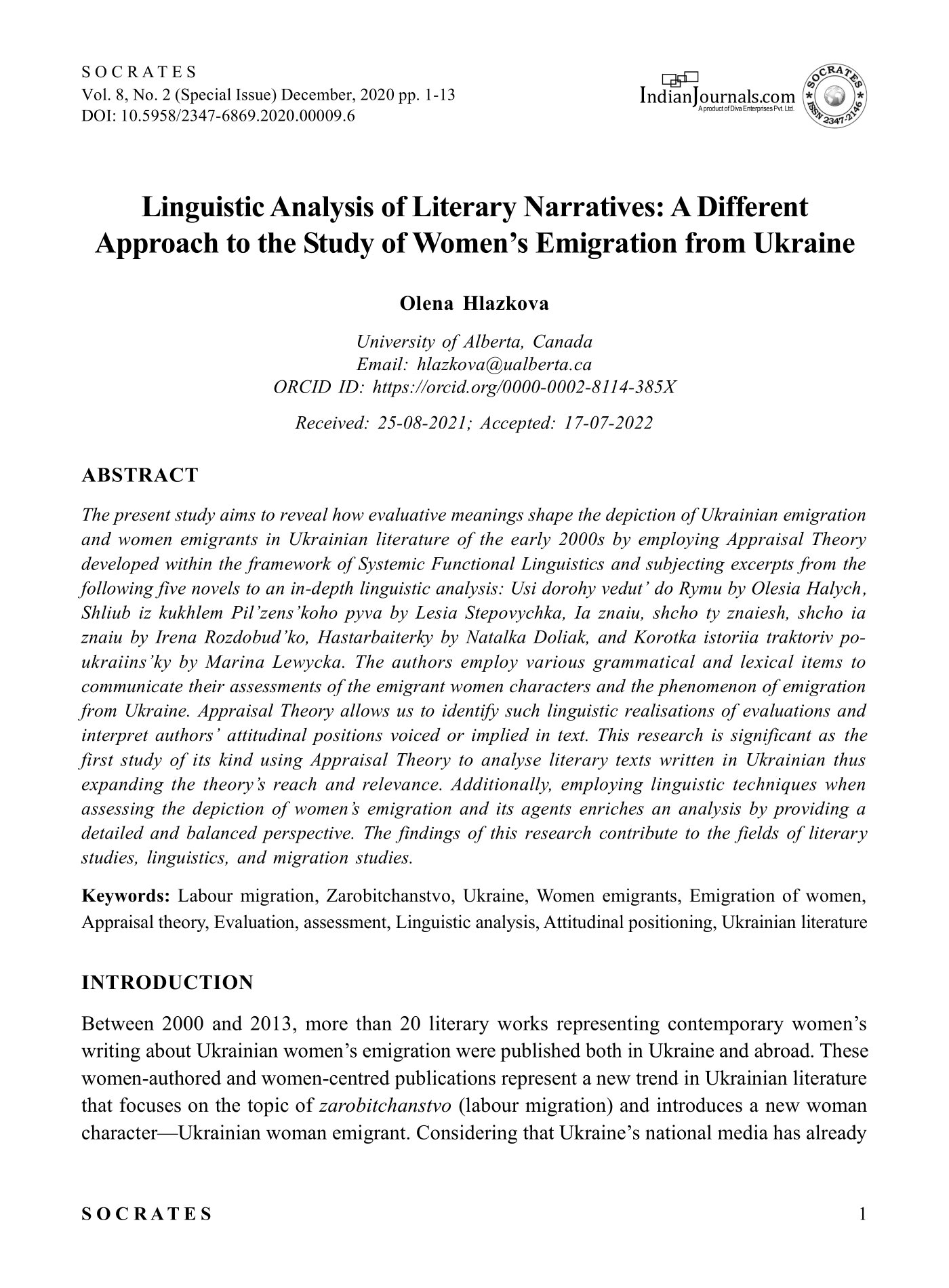
The paper authored by Olena Hlazkovais aims to reveal how evaluative meanings shape the depiction of Ukrainian emigration and women emigrants in Ukrainian literature of the early 2000s by employing Appraisal Theory developed within the framework of Systemic Functional Linguistics and subjecting excerpts from the following five novels to an in-depth linguistic analysis. This research is significant as the first study of its kind using Appraisal Theory to analyse literary texts written in Ukrainian thus expanding the theory’s reach and relevance.
The paper authored by Bartholomew Chizoba Akpah investigates the utilization of poetry by Patricia Jabbeh Wesley to challenge patriarchal dominance and expose the gimmicks of female devaluation by hegemonic imperialism. Wesley’s poems: “Inequality in Hell” and “My Auntie’s Woman-Lappa Husband”.
The paper authored by Majid Parvanehpour describes Hamid Dabashi’s narrative as related to the concept of “truth” to show that the veil issue has reached a new phase in Iran.
The paper authored by Prof. Priti Diliprao Pohekar aims at knowing the marital status of disabled (Divyaang) women/girls.
The paper authored by Dr Galyna Fesenko and Dr Tetiana Fesenko focuses on mainstreaming gender equality goals at the level of local government in Ukraine.
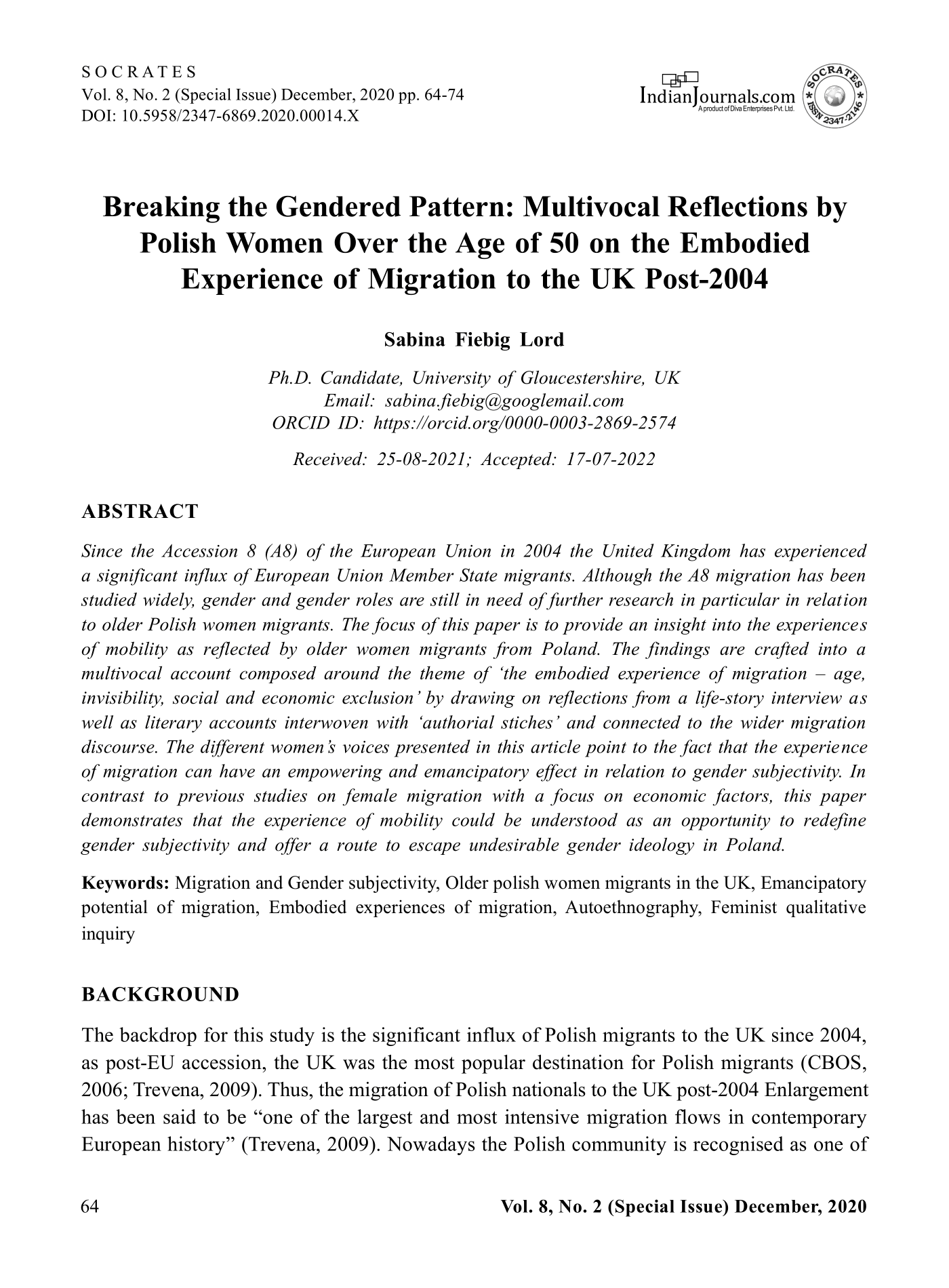
The paper authored by Sabina Fiebig Lord focuses on providing an insight into the experiences of mobility as reflected by older women migrants from Poland. In contrast to previous studies on female migration with a focus on economic factors, this paper demonstrates that the experience of mobility could be understood as an opportunity to redefine gender subjectivity and offer a route to escape undesirable gender ideology in Poland.
The paper authored by Amalia Cãlinescu proposes a theoretical analysis of A Pale View of Hills, using a psycho-literary approach to the themes of Japaneseness-Englishness, displacement, and the hybrid individual as they emerge from Kazuo Ishiguro’s novel.
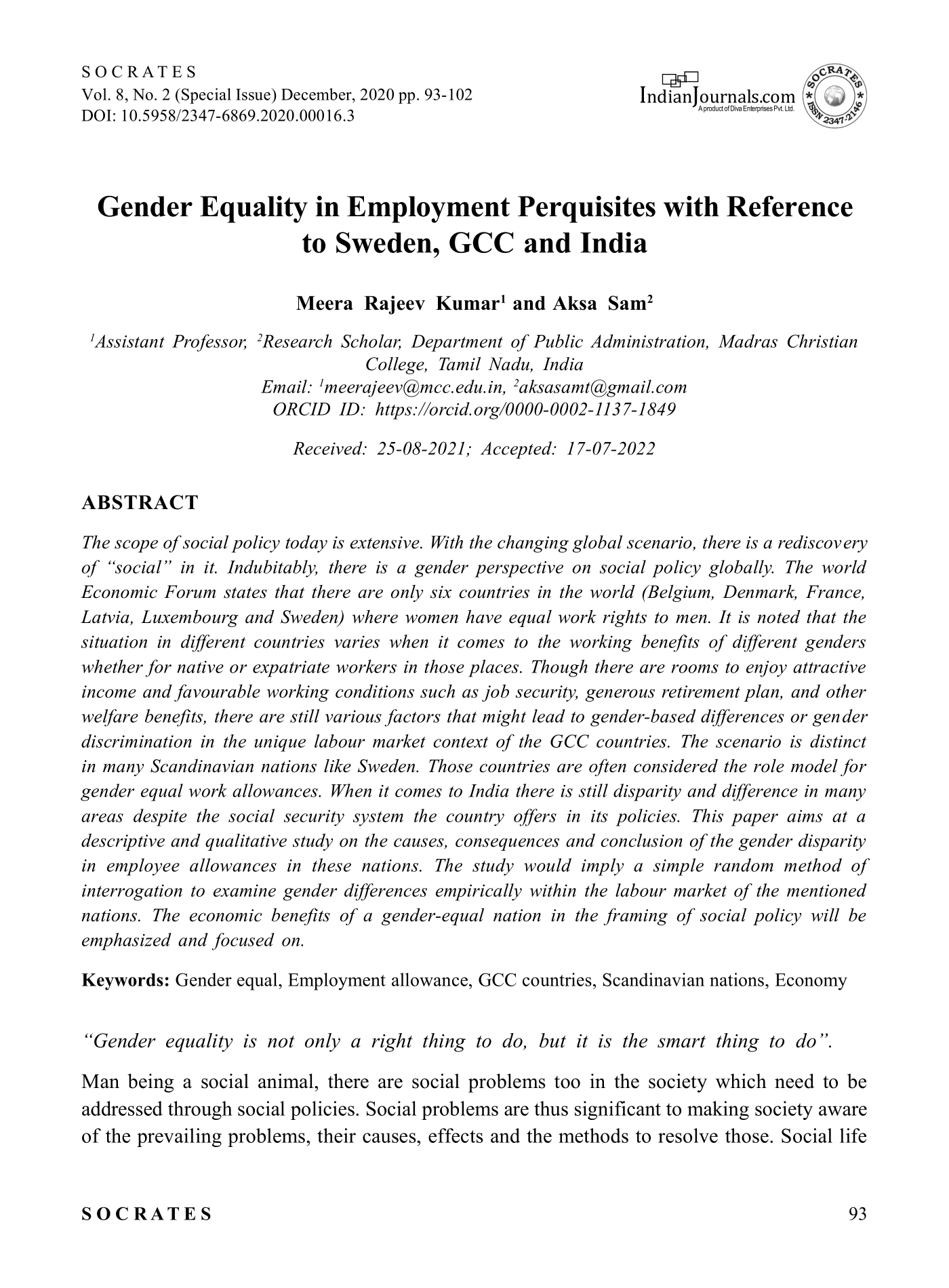
The paper authored by Dr Meera Rajeev Kumar and Aksa Sam aims at a descriptive and qualitative analysis of the causes, consequences and conclusion of the gender disparity in employee allowances in Sweden, GCC and India.
The next paper has also been authored by Dr Meera Rajeev Kumar. This paper aims to attain three objectives, firstly identifying the perception of youth about marriage, secondly, to study if “mid-life crisis” in both genders accompanied by emotional, physical and psychological issues can be the causal determinants for various issues in marriage, and thirdly, to study the causal effects between marriage issues, family laws and the country’s economy as there is a direct nexus between the three forces.
The last paper of this issue authored by Benju Dhakal and Mahesh Jaishi aims to understand the willingness among youth to pursue agriculture and gender-based differences in their opinion at the Parbat district in Nepal (Asia).
We must say that all the selected papers are very well written and relevant for the current time. They contribute to the pool of research on migration and gender issues. We are sure that the readers will find this issue of SOCRATES informative and resourceful.
Furthermore, we are grateful to the Alfred Nobel University, Ukraine and their honourable Rector Dr Sergii Kholod for the award of the ‘Order for Research Leadership’ which was presented to us during the introductory session of the 2021COMAGI 1st International Conference on Migration and Gender Issues on 11th March 2021. It is a huge honour for us to have received this award. This award will be an essential part of our lives. It will motivate us for the rest of our future always.
Editors
Prof. Dr Manoj Dixit
Dr Saurabh Chandra
Published:
18-08-2022