The Reception of Classical Persian Poetry in Anglophone World
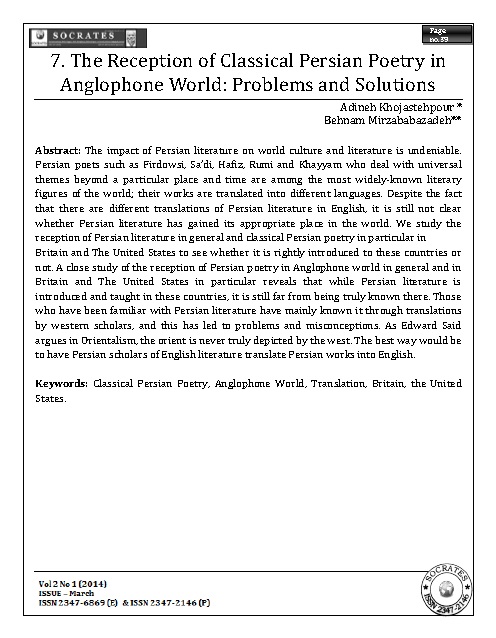
Problems and Solutions
Keywords:
Classical Persian Poetry, Anglophone World, Translation, Britain, the United States.Abstract
The impact of Persian literature on world culture and literature is undeniable. Persian poets such as Firdowsi, Sa’di, Hafiz, Rumi and Khayyam who deal with universal themes beyond a particular place and time are among the most widely-known literary figures of the world; their works are translated into different languages. Despite the fact that there are different translations of Persian literature in English, it is still not clear whether Persian literature has gained its appropriate place in the world. We study the reception of Persian literature in general and classical Persian poetry in particular in Britain and The United States to see whether it is rightly introduced to these countries or not. A close study of the reception of Persian poetry in Anglophone world in general and in Britain and The United States in particular reveals that while Persian literature is introduced and taught in these countries, it is still far from being truly known there. Those who have been familiar with Persian literature have mainly known it through translations by western scholars, and this has led to problems and misconceptions. As Edward Said argues in Orientalism, the orient is never truly depicted by the west. The best way would be to have Persian scholars of English literature translate Persian works into English.
Downloads
Downloads
Published
Issue
Section
License
Revised Copyright/CC license that applies to all the articles published after 05-02-2017
Attribution-NonCommercial 4.0 International (CC BY-NC 4.0)

Copyright/CC license that applies to all the articles published before 05-02-2017
Attribution-Non Commercial-No Derivatives 4.0 International (CC BY-NC-ND 4.0)

Author(s) will retain all the right except commercial and re-publishing rights. In the case of re-publishing, they will have to obtain written permission from the journal. Additional licensing agreements (Creative Commons licenses) grants rights to readers to copy, distribute, display and perform the work as long as you give the original author(s) credit, they can not use the works for commercial purposes and are not allowed to alter, transform, or build upon the work. For any reuse or distribution, readers and users must make clear to others the license terms of this work. Any of these conditions can be waived if you get permission from the copyright holders. Nothing in this license impairs or restricts the authors’ rights. To view a copy of this license, visit http://creativecommons.org/licenses/by-nc-nd/4.0/ or send a letter to Creative Commons, 171 Second Street, Suite 300, San Francisco, California, 94105, USA.
Research Papers published in SOCRATES are licensed under an Attribution-NonCommercial-NoDerivatives 4.0 International (CC BY-NC-ND 4.0)