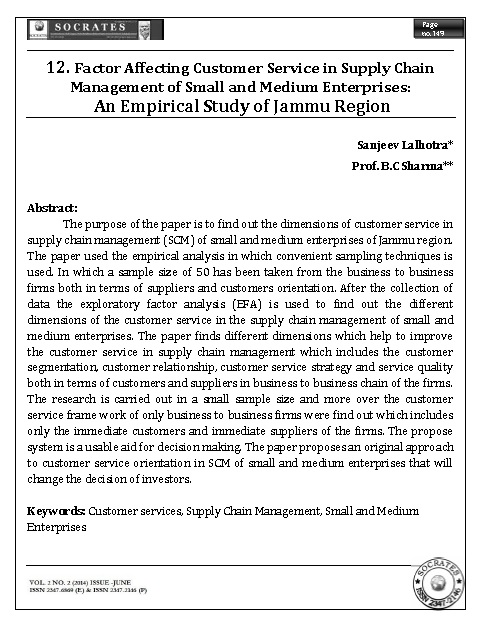
Factor Affecting Customer Service in Supply Chain Management of Small and Medium Enterprises
An Empirical Study of Jammu Region
Keywords:
Customer services, Supply Chain Management, Small and Medium EnterprisesAbstract
The purpose of the paper is to find out the dimensions of customer service in supply chain management (SCM) of small and medium enterprises of Jammu region. The paper used the empirical analysis in which convenient sampling techniques is used. In which a sample size of 50 has been taken from the business to business firms both in terms of suppliers and customers orientation. After the collection of data the exploratory factor analysis (EFA) is used to find out the different dimensions of the customer service in the supply chain management of small and medium enterprises. The paper finds different dimensions which help to improve the customer service in supply chain management which includes the customer segmentation, customer relationship, customer service strategy and service quality both in terms of customers and suppliers in business to business chain of the firms. The research is carried out in a small sample size and more over the customer service frame work of only business to business firms were find out which includes only the immediate customers and immediate suppliers of the firms. The propose system is a usable aid for decision making. The paper proposes an original approach to customer service orientation in SCM of small and medium enterprises that will change the decision of investors.
Downloads
Downloads
Published
Issue
Section
License
Revised Copyright/CC license that applies to all the articles published after 05-02-2017
Attribution-NonCommercial 4.0 International (CC BY-NC 4.0)

Copyright/CC license that applies to all the articles published before 05-02-2017
Attribution-Non Commercial-No Derivatives 4.0 International (CC BY-NC-ND 4.0)

Author(s) will retain all the right except commercial and re-publishing rights. In the case of re-publishing, they will have to obtain written permission from the journal. Additional licensing agreements (Creative Commons licenses) grants rights to readers to copy, distribute, display and perform the work as long as you give the original author(s) credit, they can not use the works for commercial purposes and are not allowed to alter, transform, or build upon the work. For any reuse or distribution, readers and users must make clear to others the license terms of this work. Any of these conditions can be waived if you get permission from the copyright holders. Nothing in this license impairs or restricts the authors’ rights. To view a copy of this license, visit http://creativecommons.org/licenses/by-nc-nd/4.0/ or send a letter to Creative Commons, 171 Second Street, Suite 300, San Francisco, California, 94105, USA.
Research Papers published in SOCRATES are licensed under an Attribution-NonCommercial-NoDerivatives 4.0 International (CC BY-NC-ND 4.0)