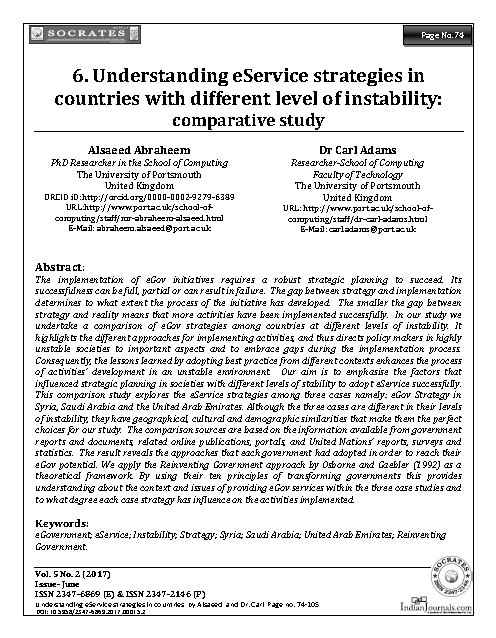
Understanding eService strategies in countries with different level of instability
comparative study
DOI:
https://doi.org/10.5958/2347-6869.2017.00015.2Keywords:
eGovernment, eService, Instability, Strategy, Syria, Saudi Arabia, United Arab Emirates, Reinventing GovernmentAbstract
The implementation of eGov initiatives requires a robust strategic planning to succeed. Its successfulness can be full, partial or can result in failure. The gap between strategy and implementation determines to what extent the process of the initiative has developed. The smaller the gap between strategy and reality means that more activities have been implemented successfully. In our study we undertake a comparison of eGov strategies among countries at different levels of instability. It highlights the different approaches for implementing activities, and thus directs policy makers in highly unstable societies to important aspects and to embrace gaps during the implementation process. Consequently, the lessons learned by adopting best practice from different contexts enhances the process of activities’ development in an unstable environment. Our aim is to emphasise the factors that influenced strategic planning in societies with different levels of stability to adopt eService successfully. This comparison study explores the eService strategies among three cases namely: eGov Strategy in Syria, Saudi Arabia and the United Arab Emirates. Although the three cases are different in their levels of instability, they have geographical, cultural and demographic similarities that make them the perfect choices for our study. The comparison sources are based on the information available from government reports and documents, related online publications, portals, and United Nations’ reports, surveys and statistics. The result reveals the approaches that each government had adopted in order to reach their eGov potential. We apply the Reinventing Government approach by Osborne and Gaebler (1992) as a theoretical framework. By using their ten principles of transforming governments this provides understanding about the context and issues of providing eGov services within the three case studies and to what degree each case strategy has influence on the activities implemented.
Article DOI : 10.5958/2347-6869.2017.00015.2
Downloads
Downloads
Published
Issue
Section
License
Copyright (c) 2017 Abraheem Alsaeed, Adams Carl, Dr.

This work is licensed under a Creative Commons Attribution-NonCommercial 4.0 International License.
Revised Copyright/CC license that applies to all the articles published after 05-02-2017
Attribution-NonCommercial 4.0 International (CC BY-NC 4.0)

Copyright/CC license that applies to all the articles published before 05-02-2017
Attribution-Non Commercial-No Derivatives 4.0 International (CC BY-NC-ND 4.0)

Author(s) will retain all the right except commercial and re-publishing rights. In the case of re-publishing, they will have to obtain written permission from the journal. Additional licensing agreements (Creative Commons licenses) grants rights to readers to copy, distribute, display and perform the work as long as you give the original author(s) credit, they can not use the works for commercial purposes and are not allowed to alter, transform, or build upon the work. For any reuse or distribution, readers and users must make clear to others the license terms of this work. Any of these conditions can be waived if you get permission from the copyright holders. Nothing in this license impairs or restricts the authors’ rights. To view a copy of this license, visit http://creativecommons.org/licenses/by-nc-nd/4.0/ or send a letter to Creative Commons, 171 Second Street, Suite 300, San Francisco, California, 94105, USA.
Research Papers published in SOCRATES are licensed under an Attribution-NonCommercial-NoDerivatives 4.0 International (CC BY-NC-ND 4.0)