E-Governance in the Age of Globalization
Challenges Ahead for India
DOI:
https://doi.org/10.5958/2347-6869.2017.00025.5Keywords:
Information technology, ICT, Electronic governance, Globalization, EGDI, EPART, GOIAbstract
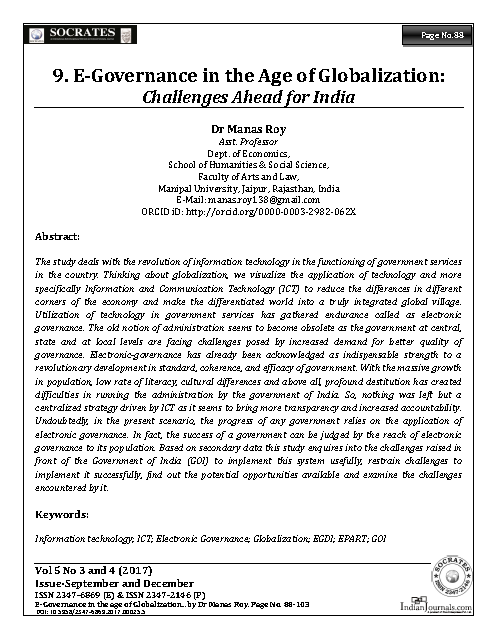
The study deals with the revolution of information technology in the functioning of government services in the country. Thinking about globalization, we visualize the application of technology and more specifically Information and Communication Technology (ICT) to reduce the differences in different corners of the economy and make the differentiated world into a truly integrated global village. Utilization of technology in government services has gathered endurance called as electronic governance. The old notion of administration seems to become obsolete as the government at central, state and at local levels are facing challenges posed by increased demand for better quality of governance. Electronic-governance has already been acknowledged as indispensable strength to a revolutionary development in standard, coherence, and efficacy of government. With the massive growth in population, low rate of literacy, cultural differences and above all, profound destitution has created difficulties in running the administration by the government of India. So, nothing was left but a centralized strategy driven by ICT as it seems to bring more transparency and increased accountability. Undoubtedly, in the present scenario, the progress of any government relies on the application of electronic governance. In fact, the success of a government can be judged by the reach of electronic governance to its population. Based on secondary data this study enquires into the challenges raised in front of the Government of India (GOI) to implement this system usefully, restrain challenges to implement it successfully, find out the potential opportunities available and examine the challenges encountered by it.
DOI: 10.5958/2347-6869.2017.00025.5
Downloads
Downloads
Published
Issue
Section
License
Copyright (c) 2018 Roy Manas

This work is licensed under a Creative Commons Attribution-NonCommercial 4.0 International License.
Revised Copyright/CC license that applies to all the articles published after 05-02-2017
Attribution-NonCommercial 4.0 International (CC BY-NC 4.0)

Copyright/CC license that applies to all the articles published before 05-02-2017
Attribution-Non Commercial-No Derivatives 4.0 International (CC BY-NC-ND 4.0)

Author(s) will retain all the right except commercial and re-publishing rights. In the case of re-publishing, they will have to obtain written permission from the journal. Additional licensing agreements (Creative Commons licenses) grants rights to readers to copy, distribute, display and perform the work as long as you give the original author(s) credit, they can not use the works for commercial purposes and are not allowed to alter, transform, or build upon the work. For any reuse or distribution, readers and users must make clear to others the license terms of this work. Any of these conditions can be waived if you get permission from the copyright holders. Nothing in this license impairs or restricts the authors’ rights. To view a copy of this license, visit http://creativecommons.org/licenses/by-nc-nd/4.0/ or send a letter to Creative Commons, 171 Second Street, Suite 300, San Francisco, California, 94105, USA.
Research Papers published in SOCRATES are licensed under an Attribution-NonCommercial-NoDerivatives 4.0 International (CC BY-NC-ND 4.0)