Aristotle's concept of the state
Keywords:
Government, state, virtue, democracy, authority, politeia, golden meanAbstract
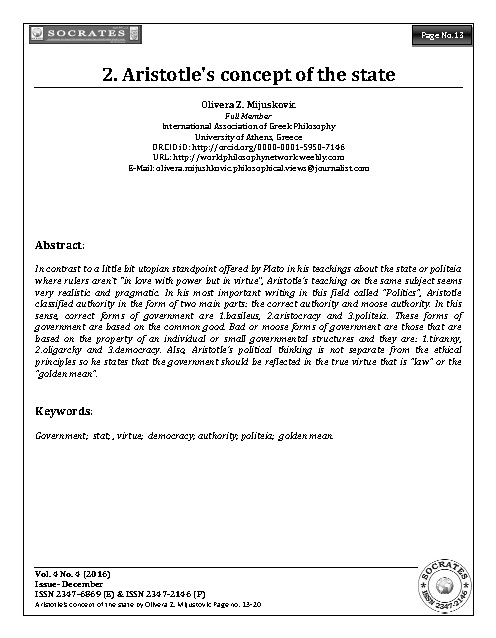
In contrast to a little bit utopian standpoint offered by Plato in his teachings about the state or politeia where rulers aren`t “in love with power but in virtue”, Aristotle's teaching on the same subject seems very realistic and pragmatic. In his most important writing in this field called "Politics", Aristotle classified authority in the form of two main parts: the correct authority and moose authority. In this sense, correct forms of government are 1.basileus, 2.aristocracy and 3.politeia. These forms of government are based on the common good. Bad or moose forms of government are those that are based on the property of an individual or small governmental structures and they are: 1.tiranny, 2.oligarchy and 3.democracy. Also, Aristotle's political thinking is not separate from the ethical principles so he states that the government should be reflected in the true virtue that is "law" or the "golden mean".
Downloads
Downloads
Published
Issue
Section
License
Revised Copyright/CC license that applies to all the articles published after 05-02-2017
Attribution-NonCommercial 4.0 International (CC BY-NC 4.0)

Copyright/CC license that applies to all the articles published before 05-02-2017
Attribution-Non Commercial-No Derivatives 4.0 International (CC BY-NC-ND 4.0)

Author(s) will retain all the right except commercial and re-publishing rights. In the case of re-publishing, they will have to obtain written permission from the journal. Additional licensing agreements (Creative Commons licenses) grants rights to readers to copy, distribute, display and perform the work as long as you give the original author(s) credit, they can not use the works for commercial purposes and are not allowed to alter, transform, or build upon the work. For any reuse or distribution, readers and users must make clear to others the license terms of this work. Any of these conditions can be waived if you get permission from the copyright holders. Nothing in this license impairs or restricts the authors’ rights. To view a copy of this license, visit http://creativecommons.org/licenses/by-nc-nd/4.0/ or send a letter to Creative Commons, 171 Second Street, Suite 300, San Francisco, California, 94105, USA.
Research Papers published in SOCRATES are licensed under an Attribution-NonCommercial-NoDerivatives 4.0 International (CC BY-NC-ND 4.0)