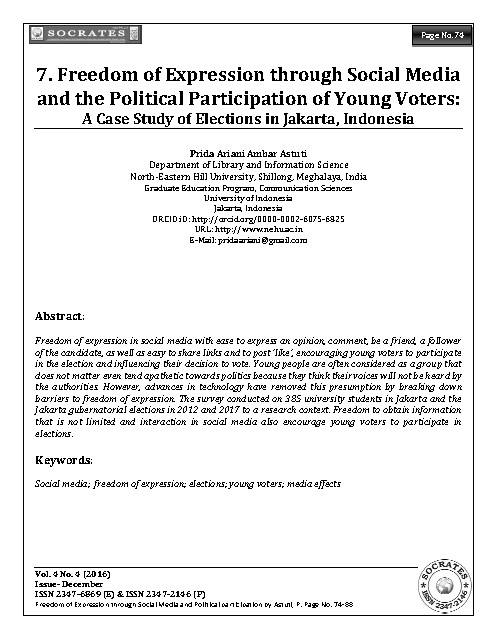
Freedom of Expression through Social Media and the Political Participation of Young Voters
A Case Study of Elections in Jakarta, Indonesia
Keywords:
Social media, freedom of expression, elections, young voters, media effectsAbstract
Freedom of expression in social media with ease to express an opinion, comment, be a friend, a follower of the candidate, as well as easy to share links and to post 'like', encouraging young voters to participate in the election and influencing their decision to vote. Young people are often considered as a group that does not matter even tend apathetic towards politics because they think their voices will not be heard by the authorities. However, advances in technology have removed this presumption by breaking down barriers to freedom of expression. The survey conducted on 385 university students in Jakarta and the Jakarta gubernatorial elections in 2012 and 2017 to a research context. Freedom to obtain information that is not limited and interaction in social media also encourage young voters to participate in elections.
Downloads
Downloads
Additional Files
Published
Issue
Section
License
Revised Copyright/CC license that applies to all the articles published after 05-02-2017
Attribution-NonCommercial 4.0 International (CC BY-NC 4.0)

Copyright/CC license that applies to all the articles published before 05-02-2017
Attribution-Non Commercial-No Derivatives 4.0 International (CC BY-NC-ND 4.0)

Author(s) will retain all the right except commercial and re-publishing rights. In the case of re-publishing, they will have to obtain written permission from the journal. Additional licensing agreements (Creative Commons licenses) grants rights to readers to copy, distribute, display and perform the work as long as you give the original author(s) credit, they can not use the works for commercial purposes and are not allowed to alter, transform, or build upon the work. For any reuse or distribution, readers and users must make clear to others the license terms of this work. Any of these conditions can be waived if you get permission from the copyright holders. Nothing in this license impairs or restricts the authors’ rights. To view a copy of this license, visit http://creativecommons.org/licenses/by-nc-nd/4.0/ or send a letter to Creative Commons, 171 Second Street, Suite 300, San Francisco, California, 94105, USA.
Research Papers published in SOCRATES are licensed under an Attribution-NonCommercial-NoDerivatives 4.0 International (CC BY-NC-ND 4.0)