The role of policy space in technology evolution
Evidence from India and what Ghana can learn
Keywords:
Policy Space, Technology Evolution, India, Ghana, Pharmaceutical and SoftwareAbstract
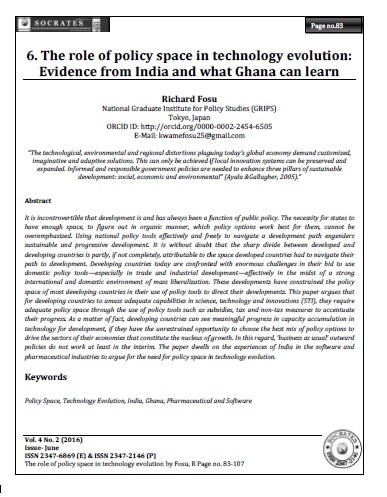
It is incontrovertible that development is and has always been a function of public policy. The necessity for states to have enough space, to figure out in organic manner, which policy options work best for them, cannot be overemphasized. Using national policy tools effectively and freely to navigate a development path engenders sustainable and progressive development. It is without doubt that the sharp divide between developed and developing countries is partly, if not completely, attributable to the space developed countries had to navigate their path to development. Developing countries today are confronted with enormous challenges in their bid to use domestic policy tools—especially in trade and industrial development—effectively in the midst of a strong international and domestic environment of mass liberalization. These developments have constrained the policy space of most developing countries in their use of policy tools to direct their developments. This paper argues that for developing countries to amass adequate capabilities in science, technology and innovations (STI), they require adequate policy space through the use of policy tools such as subsidies, tax and non-tax measures to accentuate their progress. As a matter of fact, developing countries can see meaningful progress in capacity accumulation in technology for development, if they have the unrestrained opportunity to choose the best mix of policy options to drive the sectors of their economies that constitute the nucleus of growth. In this regard, ‘business as usual’ outward policies do not work at least in the interim. The paper dwells on the experiences of India in the software and pharmaceutical industries to argue for the need for policy space in technology evolution.
Downloads
Downloads
Published
Issue
Section
License
Revised Copyright/CC license that applies to all the articles published after 05-02-2017
Attribution-NonCommercial 4.0 International (CC BY-NC 4.0)

Copyright/CC license that applies to all the articles published before 05-02-2017
Attribution-Non Commercial-No Derivatives 4.0 International (CC BY-NC-ND 4.0)

Author(s) will retain all the right except commercial and re-publishing rights. In the case of re-publishing, they will have to obtain written permission from the journal. Additional licensing agreements (Creative Commons licenses) grants rights to readers to copy, distribute, display and perform the work as long as you give the original author(s) credit, they can not use the works for commercial purposes and are not allowed to alter, transform, or build upon the work. For any reuse or distribution, readers and users must make clear to others the license terms of this work. Any of these conditions can be waived if you get permission from the copyright holders. Nothing in this license impairs or restricts the authors’ rights. To view a copy of this license, visit http://creativecommons.org/licenses/by-nc-nd/4.0/ or send a letter to Creative Commons, 171 Second Street, Suite 300, San Francisco, California, 94105, USA.
Research Papers published in SOCRATES are licensed under an Attribution-NonCommercial-NoDerivatives 4.0 International (CC BY-NC-ND 4.0)