Effectiveness of Public Distribution System in Jammu & Kashmir
Keywords:
PDS (Public Distribution System), Fair Price Shop, Social Security, Essential CommoditiesAbstract
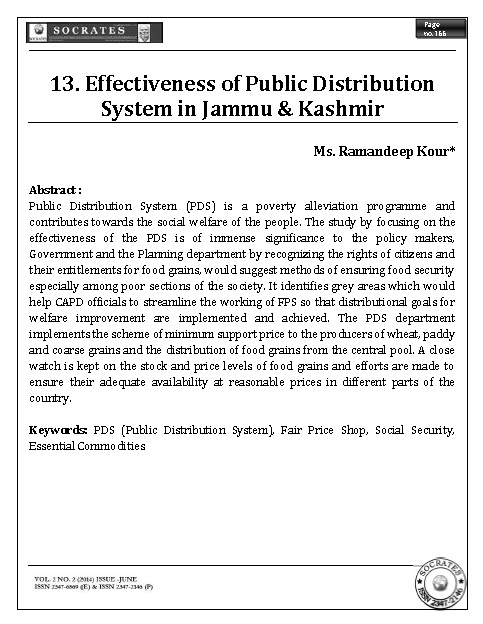
Public Distribution System (PDS) is a poverty alleviation programme and contributes towards the social welfare of the people. The study by focusing on the effectiveness of the PDS is of immense significance to the policy makers, Government and the Planning department by recognizing the rights of citizens and their entitlements for food grains, would suggest methods of ensuring food security especially among poor sections of the society. It identifies grey areas which would help CAPD officials to streamline the working of FPS so that distributional goals for welfare improvement are implemented and achieved. The PDS department implements the scheme of minimum support price to the producers of wheat, paddy and coarse grains and the distribution of food grains from the central pool. A close watch is kept on the stock and price levels of food grains and efforts are made to ensure their adequate availability at reasonable prices in different parts of the country.
Downloads
Downloads
Published
Issue
Section
License
Revised Copyright/CC license that applies to all the articles published after 05-02-2017
Attribution-NonCommercial 4.0 International (CC BY-NC 4.0)

Copyright/CC license that applies to all the articles published before 05-02-2017
Attribution-Non Commercial-No Derivatives 4.0 International (CC BY-NC-ND 4.0)

Author(s) will retain all the right except commercial and re-publishing rights. In the case of re-publishing, they will have to obtain written permission from the journal. Additional licensing agreements (Creative Commons licenses) grants rights to readers to copy, distribute, display and perform the work as long as you give the original author(s) credit, they can not use the works for commercial purposes and are not allowed to alter, transform, or build upon the work. For any reuse or distribution, readers and users must make clear to others the license terms of this work. Any of these conditions can be waived if you get permission from the copyright holders. Nothing in this license impairs or restricts the authors’ rights. To view a copy of this license, visit http://creativecommons.org/licenses/by-nc-nd/4.0/ or send a letter to Creative Commons, 171 Second Street, Suite 300, San Francisco, California, 94105, USA.
Research Papers published in SOCRATES are licensed under an Attribution-NonCommercial-NoDerivatives 4.0 International (CC BY-NC-ND 4.0)