The Concept of Radif and Three Paradigms of Persian Music in Contemporary Iran
DOI:
https://doi.org/10.5958/2347-6869.2017.00019.XKeywords:
Persian music, Iran, Radif, Paradigm, PhilosophyAbstract
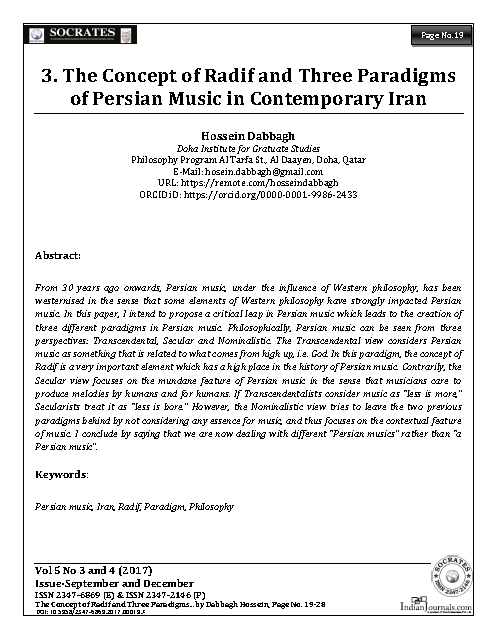
From 30 years ago onwards, Persian music, under the influence of Western philosophy, has been Westernised in the sense that some elements of Western philosophy have strongly impacted Persian music. In this paper, I intend to propose a critical leap in Persian music which leads to the creation of three different paradigms in Persian music. Philosophically, Persian music can be seen from three perspectives: Transcendental, Secular and Nominalistic. The Transcendental view considers Persian music as something that is related to what comes from high up, i.e. God. In this paradigm, the concept of Radif is a very important element which has a high place in the history of Persian music. Contrarily, the Secular view focuses on the mundane feature of Persian music in the sense that musicians care to produce melodies by humans and for humans. If Transcendentalists consider music as “less is more,” Secularists treat it as “less is bore.” However, the Nominalistic view tries to leave the two previous paradigms behind by not considering any essence for music, and thus focuses on the contextual feature of music. I conclude by saying that we are now dealing with different “Persian musics” rather than “a Persian music”.
DOI: 10.5958/2347-6869.2017.00019.X
Downloads
Downloads
Published
Issue
Section
License
Copyright (c) 2018 Dabbagh Hossein

This work is licensed under a Creative Commons Attribution-NonCommercial 4.0 International License.
Revised Copyright/CC license that applies to all the articles published after 05-02-2017
Attribution-NonCommercial 4.0 International (CC BY-NC 4.0)

Copyright/CC license that applies to all the articles published before 05-02-2017
Attribution-Non Commercial-No Derivatives 4.0 International (CC BY-NC-ND 4.0)

Author(s) will retain all the right except commercial and re-publishing rights. In the case of re-publishing, they will have to obtain written permission from the journal. Additional licensing agreements (Creative Commons licenses) grants rights to readers to copy, distribute, display and perform the work as long as you give the original author(s) credit, they can not use the works for commercial purposes and are not allowed to alter, transform, or build upon the work. For any reuse or distribution, readers and users must make clear to others the license terms of this work. Any of these conditions can be waived if you get permission from the copyright holders. Nothing in this license impairs or restricts the authors’ rights. To view a copy of this license, visit http://creativecommons.org/licenses/by-nc-nd/4.0/ or send a letter to Creative Commons, 171 Second Street, Suite 300, San Francisco, California, 94105, USA.
Research Papers published in SOCRATES are licensed under an Attribution-NonCommercial-NoDerivatives 4.0 International (CC BY-NC-ND 4.0)