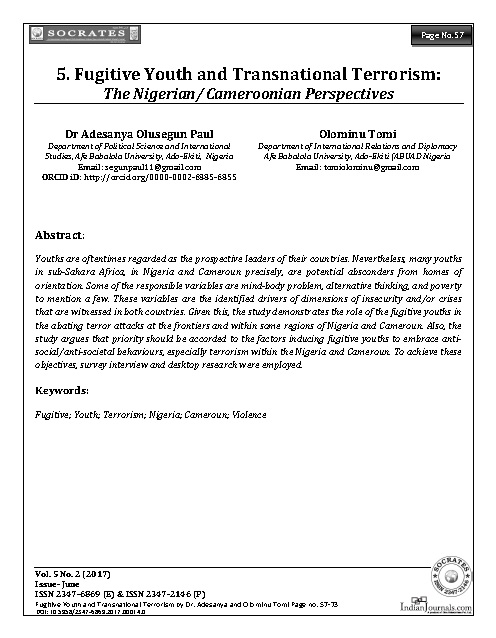
Fugitive Youth and Transnational Terrorism
The Nigerian/ Cameroonian Perspectives
DOI:
https://doi.org/10.5958/2347-6869.2017.00014.0Keywords:
Fugitive, Youth, Terrorism, Nigeria, Cameroun, ViolenceAbstract
Youths are oftentimes regarded as the prospective leaders of their countries. Nevertheless, many youths in sub-Sahara Africa, in Nigeria and Cameroun precisely, are potential absconders from homes of orientation. Some of the responsible variables are mind-body problem, alternative thinking, and poverty to mention a few. These variables are the identified drivers of dimensions of insecurity and/or crises that are witnessed in both countries. Given this, the study demonstrates the role of the fugitive youths in the abating terror attacks at the frontiers and within some regions of Nigeria and Cameroun. Also, the study argues that priority should be accorded to the factors inducing fugitive youths to embrace antisocial/ anti-societal behaviours, especially terrorism within the Nigeria and Cameroun. To achieve these objectives, survey interview and desktop research were employed.
Downloads
Downloads
Published
Issue
Section
License
Copyright (c) 2017 Paul Adesanya Olusegun, Dr., Tomi Olominu

This work is licensed under a Creative Commons Attribution-NonCommercial 4.0 International License.
Revised Copyright/CC license that applies to all the articles published after 05-02-2017
Attribution-NonCommercial 4.0 International (CC BY-NC 4.0)

Copyright/CC license that applies to all the articles published before 05-02-2017
Attribution-Non Commercial-No Derivatives 4.0 International (CC BY-NC-ND 4.0)

Author(s) will retain all the right except commercial and re-publishing rights. In the case of re-publishing, they will have to obtain written permission from the journal. Additional licensing agreements (Creative Commons licenses) grants rights to readers to copy, distribute, display and perform the work as long as you give the original author(s) credit, they can not use the works for commercial purposes and are not allowed to alter, transform, or build upon the work. For any reuse or distribution, readers and users must make clear to others the license terms of this work. Any of these conditions can be waived if you get permission from the copyright holders. Nothing in this license impairs or restricts the authors’ rights. To view a copy of this license, visit http://creativecommons.org/licenses/by-nc-nd/4.0/ or send a letter to Creative Commons, 171 Second Street, Suite 300, San Francisco, California, 94105, USA.
Research Papers published in SOCRATES are licensed under an Attribution-NonCommercial-NoDerivatives 4.0 International (CC BY-NC-ND 4.0)