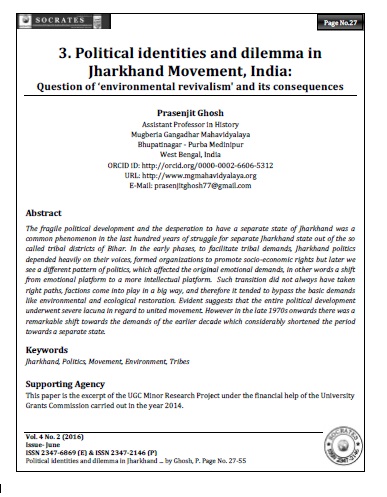
Political identities and dilemma in Jharkhand Movement, India
Question of ‘environmental revivalism' and its consequences
Keywords:
Jharkhand, Politics, Movement, Environment, TribesAbstract
The fragile political development and the desperation to have a separate state of Jharkhand was a common phenomenon in the last hundred years of struggle for separate Jharkhand state out of the so called tribal districts of Bihar. In the early phases, to facilitate tribal demands, Jharkhand politics depended heavily on their voices, formed organizations to promote socio-economic rights but later we see a different pattern of politics, which affected the original emotional demands, in other words a shift from emotional platform to a more intellectual platform. Such transition did not always have taken right paths, factions come into play in a big way, and therefore it tended to bypass the basic demands like environmental and ecological restoration. Evident suggests that the entire political development underwent severe lacuna in regard to united movement. However in the late 1970s onwards there was a remarkable shift towards the demands of the earlier decade which considerably shortened the period towards a separate state.
Downloads
Downloads
Published
Issue
Section
License
Revised Copyright/CC license that applies to all the articles published after 05-02-2017
Attribution-NonCommercial 4.0 International (CC BY-NC 4.0)

Copyright/CC license that applies to all the articles published before 05-02-2017
Attribution-Non Commercial-No Derivatives 4.0 International (CC BY-NC-ND 4.0)

Author(s) will retain all the right except commercial and re-publishing rights. In the case of re-publishing, they will have to obtain written permission from the journal. Additional licensing agreements (Creative Commons licenses) grants rights to readers to copy, distribute, display and perform the work as long as you give the original author(s) credit, they can not use the works for commercial purposes and are not allowed to alter, transform, or build upon the work. For any reuse or distribution, readers and users must make clear to others the license terms of this work. Any of these conditions can be waived if you get permission from the copyright holders. Nothing in this license impairs or restricts the authors’ rights. To view a copy of this license, visit http://creativecommons.org/licenses/by-nc-nd/4.0/ or send a letter to Creative Commons, 171 Second Street, Suite 300, San Francisco, California, 94105, USA.
Research Papers published in SOCRATES are licensed under an Attribution-NonCommercial-NoDerivatives 4.0 International (CC BY-NC-ND 4.0)