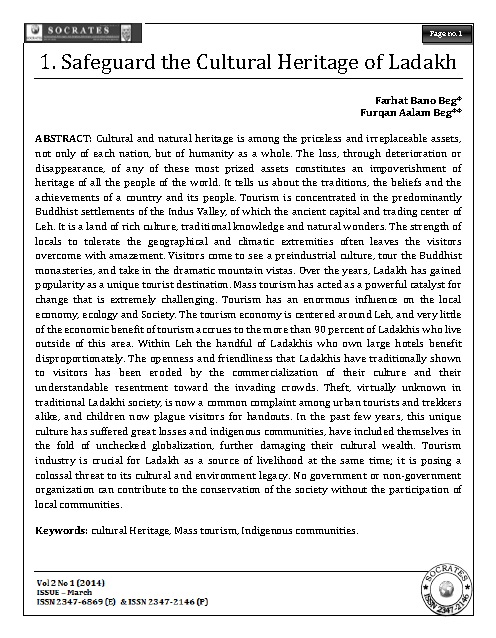
Safeguard the Cultural Heritage of Ladakh
Keywords:
Cultural heritage, Mass tourism, Indigenous communitiesAbstract
Cultural and natural heritage is among the priceless and irreplaceable assets, not only of each nation, but of humanity as a whole. The loss, through deterioration or disappearance, of any of these most prized assets constitutes an impoverishment of heritage of all the people of the world. It tells us about the traditions, the beliefs and the achievements of a country and its people. Tourism is concentrated in the predominantly Buddhist settlements of the Indus Valley, of which the ancient capital and trading center of Leh. It is a land of rich culture, traditional knowledge and natural wonders. The strength of locals to tolerate the geographical and climatic extremities often leaves the visitors overcome with amazement. Visitors come to see a preindustrial culture, tour the Buddhist monasteries, and take in the dramatic mountain vistas. Over the years, Ladakh has gained popularity as a unique tourist destination. Mass tourism has acted as a powerful catalyst for change that is extremely challenging. Tourism has an enormous influence on the local economy, ecology and Society. The tourism economy is centered around Leh, and very little of the economic benefit of tourism accrues to the more than 90 percent of Ladakhis who live outside of this area. Within Leh the handful of Ladakhis who own large hotels benefit disproportionately. The openness and friendliness that Ladakhis have traditionally shown to visitors has been eroded by the commercialization of their culture and their understandable resentment toward the invading crowds. Theft, virtually unknown in traditional Ladakhi society, is now a common complaint among urban tourists and trekkers alike, and children now plague visitors for handouts. In the past few years, this unique culture has suffered great losses and indigenous communities, have included themselves in the fold of unchecked globalization, further damaging their cultural wealth. Tourism industry is crucial for Ladakh as a source of livelihood at the same time; it is posing a colossal threat to its cultural and environment legacy. No government or non-government organization can contribute to the conservation of the society without the participation of local communities.
Downloads
Downloads
Published
Issue
Section
License
Revised Copyright/CC license that applies to all the articles published after 05-02-2017
Attribution-NonCommercial 4.0 International (CC BY-NC 4.0)

Copyright/CC license that applies to all the articles published before 05-02-2017
Attribution-Non Commercial-No Derivatives 4.0 International (CC BY-NC-ND 4.0)

Author(s) will retain all the right except commercial and re-publishing rights. In the case of re-publishing, they will have to obtain written permission from the journal. Additional licensing agreements (Creative Commons licenses) grants rights to readers to copy, distribute, display and perform the work as long as you give the original author(s) credit, they can not use the works for commercial purposes and are not allowed to alter, transform, or build upon the work. For any reuse or distribution, readers and users must make clear to others the license terms of this work. Any of these conditions can be waived if you get permission from the copyright holders. Nothing in this license impairs or restricts the authors’ rights. To view a copy of this license, visit http://creativecommons.org/licenses/by-nc-nd/4.0/ or send a letter to Creative Commons, 171 Second Street, Suite 300, San Francisco, California, 94105, USA.
Research Papers published in SOCRATES are licensed under an Attribution-NonCommercial-NoDerivatives 4.0 International (CC BY-NC-ND 4.0)