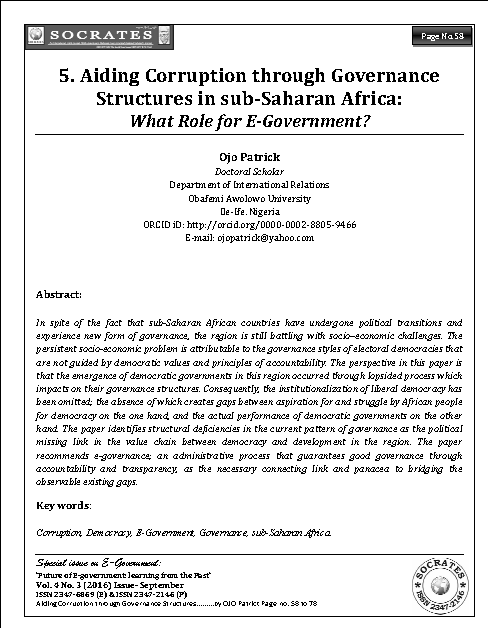
Aiding Corruption through Governance Structures in sub-Saharan Africa
What Role for E-Government?
Keywords:
Corruption, Democracy, E-Government, Governance, sub-Saharan AfricaAbstract
In spite of the fact that sub-Saharan African countries have undergone political transitions and experience new form of governance, the region is still battling with socio–economic challenges. The persistent socio-economic problem is attributable to the governance styles of electoral democracies that are not guided by democratic values and principles of accountability. The perspective in this paper is that the emergence of democratic governments in this region occurred through lopsided process which impacts on their governance structures. Consequently, the institutionalization of liberal democracy has been omitted; the absence of which creates gaps between aspiration for and struggle by African people for democracy on the one hand, and the actual performance of democratic governments on the other hand. The paper identifies structural deficiencies in the current pattern of governance as the political missing link in the value chain between democracy and development in the region. The paper recommends e-governance; an administrative process that guarantees good governance through accountability and transparency, as the necessary connecting link and panacea to bridging the observable existing gaps.
Downloads
Downloads
Published
Issue
Section
License
Revised Copyright/CC license that applies to all the articles published after 05-02-2017
Attribution-NonCommercial 4.0 International (CC BY-NC 4.0)

Copyright/CC license that applies to all the articles published before 05-02-2017
Attribution-Non Commercial-No Derivatives 4.0 International (CC BY-NC-ND 4.0)

Author(s) will retain all the right except commercial and re-publishing rights. In the case of re-publishing, they will have to obtain written permission from the journal. Additional licensing agreements (Creative Commons licenses) grants rights to readers to copy, distribute, display and perform the work as long as you give the original author(s) credit, they can not use the works for commercial purposes and are not allowed to alter, transform, or build upon the work. For any reuse or distribution, readers and users must make clear to others the license terms of this work. Any of these conditions can be waived if you get permission from the copyright holders. Nothing in this license impairs or restricts the authors’ rights. To view a copy of this license, visit http://creativecommons.org/licenses/by-nc-nd/4.0/ or send a letter to Creative Commons, 171 Second Street, Suite 300, San Francisco, California, 94105, USA.
Research Papers published in SOCRATES are licensed under an Attribution-NonCommercial-NoDerivatives 4.0 International (CC BY-NC-ND 4.0)