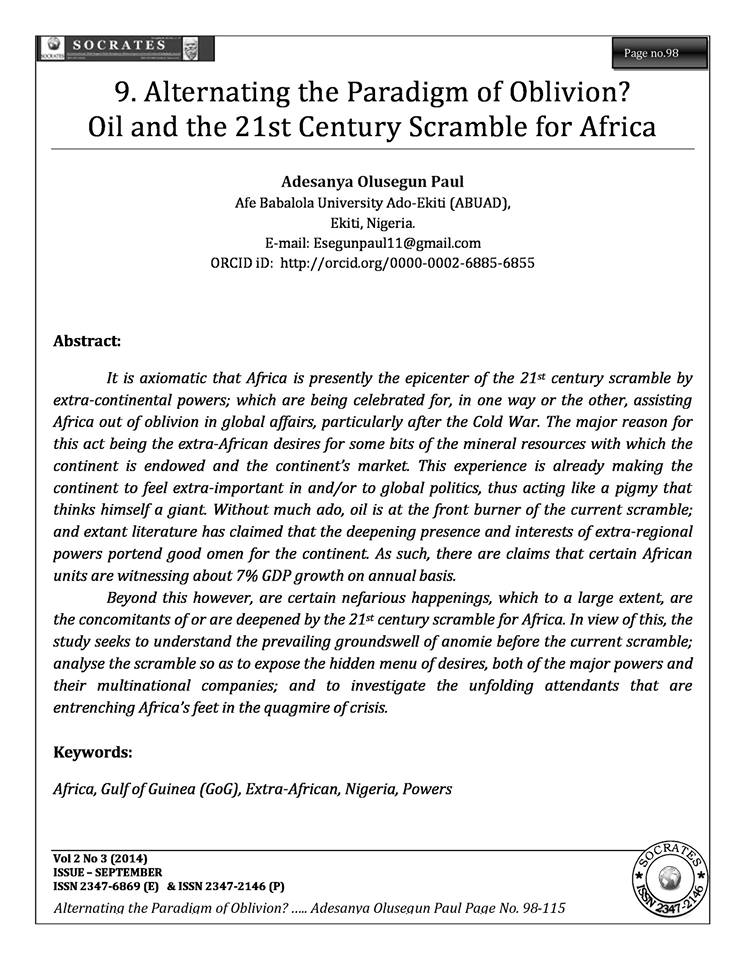
Alternating the Paradigm of Oblivion? Oil and the 21st Century Scramble for Africa
Keywords:
Africa, Gulf of Guinea (GoG), Extra-African, Nigeria, PowersAbstract
It is axiomatic that Africa is presently the epicenter of the 21st century scramble by extra-continental powers; which are being celebrated for, in one way or the other, assisting Africa out of oblivion in global affairs, particularly after the Cold War. The major reason for this act being the extra-African desires for some bits of the mineral resources with which the continent is endowed and the continent’s market. This experience is already making the continent to feel extra-important in and/or to global politics, thus acting like a pigmy that thinks himself a giant. Without much ado, oil is at the front burner of the current scramble; and extant literature has claimed that the deepening presence and interests of extra-regional powers portend good omen for the continent. As such, there are claims that certain African units are witnessing about 7% GDP growth on annual basis. Beyond this however, are certain nefarious happenings, which to a large extent, are the concomitants of or are deepened by the 21st century scramble for Africa. In view of this, the study seeks to understand the prevailing groundswell of anomie before the current scramble; analyse the scramble so as to expose the hidden menu of desires, both of the major powers and their multinational companies; and to investigate the unfolding attendants that are entrenching Africa’s feet in the quagmire of crisis.
Downloads
Downloads
Published
Issue
Section
License
Revised Copyright/CC license that applies to all the articles published after 05-02-2017
Attribution-NonCommercial 4.0 International (CC BY-NC 4.0)

Copyright/CC license that applies to all the articles published before 05-02-2017
Attribution-Non Commercial-No Derivatives 4.0 International (CC BY-NC-ND 4.0)

Author(s) will retain all the right except commercial and re-publishing rights. In the case of re-publishing, they will have to obtain written permission from the journal. Additional licensing agreements (Creative Commons licenses) grants rights to readers to copy, distribute, display and perform the work as long as you give the original author(s) credit, they can not use the works for commercial purposes and are not allowed to alter, transform, or build upon the work. For any reuse or distribution, readers and users must make clear to others the license terms of this work. Any of these conditions can be waived if you get permission from the copyright holders. Nothing in this license impairs or restricts the authors’ rights. To view a copy of this license, visit http://creativecommons.org/licenses/by-nc-nd/4.0/ or send a letter to Creative Commons, 171 Second Street, Suite 300, San Francisco, California, 94105, USA.
Research Papers published in SOCRATES are licensed under an Attribution-NonCommercial-NoDerivatives 4.0 International (CC BY-NC-ND 4.0)