Africa’s Science and Technology Strategy in the Thought of Kwame Nkrumah
Keywords:
Science and Technology, Africa, African Union, Kwame Nkrumah, Pan-AfricanismAbstract
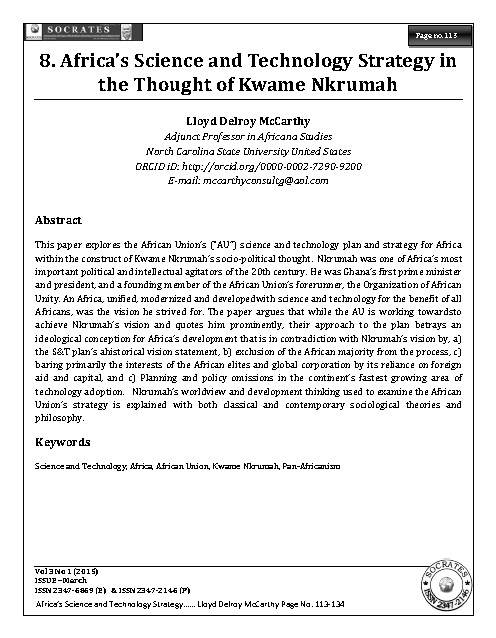
This paper explores the African Union’s (“AU”) science and technology plan and strategy for Africa within the construct of Kwame Nkrumah’s socio-political thought. Nkrumah was one of Africa’s most important political and intellectual agitators of the 20th century. He was Ghana’s first prime minister and president, and a founding member of the African Union’s forerunner, the Organization of African Unity. An Africa, unified, modernized and developedwith science and technology for the benefit of all Africans, was the vision he strived for. The paper argues that while the AU is working towardsto achieve Nkrumah’s vision and quotes him prominently, their approach to the plan betrays an ideological conception for Africa’s development that is in contradiction with Nkrumah’s vision by, a) the S&T plan’s ahistorical vision statement, b) exclusion of the African majority from the process, c) baring primarily the interests of the African elites and global corporation by its reliance on foreign aid and capital, and c) Planning and policy omissions in the continent’s fastest growing area of technology adoption. Nkrumah’s worldview and development thinking used to examine the African Union’s strategy is explained with both classical and contemporary sociological theories and philosophy.
Downloads
Downloads
Published
Issue
Section
License
Revised Copyright/CC license that applies to all the articles published after 05-02-2017
Attribution-NonCommercial 4.0 International (CC BY-NC 4.0)

Copyright/CC license that applies to all the articles published before 05-02-2017
Attribution-Non Commercial-No Derivatives 4.0 International (CC BY-NC-ND 4.0)

Author(s) will retain all the right except commercial and re-publishing rights. In the case of re-publishing, they will have to obtain written permission from the journal. Additional licensing agreements (Creative Commons licenses) grants rights to readers to copy, distribute, display and perform the work as long as you give the original author(s) credit, they can not use the works for commercial purposes and are not allowed to alter, transform, or build upon the work. For any reuse or distribution, readers and users must make clear to others the license terms of this work. Any of these conditions can be waived if you get permission from the copyright holders. Nothing in this license impairs or restricts the authors’ rights. To view a copy of this license, visit http://creativecommons.org/licenses/by-nc-nd/4.0/ or send a letter to Creative Commons, 171 Second Street, Suite 300, San Francisco, California, 94105, USA.
Research Papers published in SOCRATES are licensed under an Attribution-NonCommercial-NoDerivatives 4.0 International (CC BY-NC-ND 4.0)