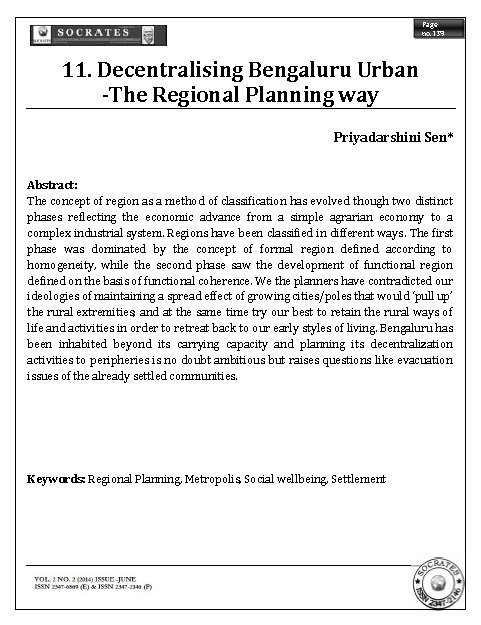
Decentralising Bengaluru Urban
-The Regional Planning way
Keywords:
Regional Planning, Metropolis, Social wellbeing, SettlementAbstract
The concept of region as a method of classification has evolved though two distinct phases reflecting the economic advance from a simple agrarian economy to a complex industrial system. Regions have been classified in different ways. The first phase was dominated by the concept of formal region defined according to homogeneity, while the second phase saw the development of functional region defined on the basis of functional coherence. We the planners have contradicted our ideologies of maintaining a spread effect of growing cities/poles that would ‘pull up’ the rural extremities; and at the same time try our best to retain the rural ways of life and activities in order to retreat back to our early styles of living. Bengaluru has been inhabited beyond its carrying capacity and planning its decentralization activities to peripheries is no doubt ambitious but raises questions like evacuation issues of the already settled communities.
Downloads
Downloads
Published
Issue
Section
License
Revised Copyright/CC license that applies to all the articles published after 05-02-2017
Attribution-NonCommercial 4.0 International (CC BY-NC 4.0)

Copyright/CC license that applies to all the articles published before 05-02-2017
Attribution-Non Commercial-No Derivatives 4.0 International (CC BY-NC-ND 4.0)

Author(s) will retain all the right except commercial and re-publishing rights. In the case of re-publishing, they will have to obtain written permission from the journal. Additional licensing agreements (Creative Commons licenses) grants rights to readers to copy, distribute, display and perform the work as long as you give the original author(s) credit, they can not use the works for commercial purposes and are not allowed to alter, transform, or build upon the work. For any reuse or distribution, readers and users must make clear to others the license terms of this work. Any of these conditions can be waived if you get permission from the copyright holders. Nothing in this license impairs or restricts the authors’ rights. To view a copy of this license, visit http://creativecommons.org/licenses/by-nc-nd/4.0/ or send a letter to Creative Commons, 171 Second Street, Suite 300, San Francisco, California, 94105, USA.
Research Papers published in SOCRATES are licensed under an Attribution-NonCommercial-NoDerivatives 4.0 International (CC BY-NC-ND 4.0)