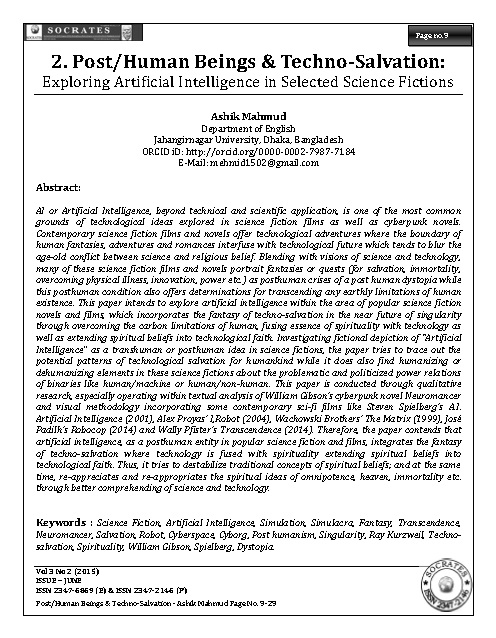
Post/Human Beings & Techno-Salvation
Exploring Artificial Intelligence in Selected Science Fictions
Keywords:
Science Fiction, Artificial Intelligence, Simulation, Simulacra, Fantasy, Transcendence, Neuromancer, Salvation, Robot, Cyberspace, Cyborg, Post humanism, Singularity, Ray Kurzweil, Technosalvation, Spirituality, William Gibson, Spielberg, DystopiaAbstract
AI or Artificial Intelligence, beyond technical and scientific application, is one of the most common grounds of technological ideas explored in science fiction films as well as cyberpunk novels. Contemporary science fiction films and novels offer technological adventures where the boundary of human fantasies, adventures and romances interfuse with technological future which tends to blur the age-old conflict between science and religious belief. Blending with visions of science and technology, many of these science fiction films and novels portrait fantasies or quests (for salvation, immortality, overcoming physical illness, innovation, power etc.) as posthuman crises of a post human dystopia while this posthuman condition also offers determinations for transcending any earthly limitations of human existence. This paper intends to explore artificial intelligence within the area of popular science fiction novels and films, which incorporates the fantasy of techno-salvation in the near future of singularity through overcoming the carbon limitations of human, fusing essence of spirituality with technology as well as extending spiritual beliefs into technological faith. Investigating fictional depiction of “Artificial Intelligence” as a transhuman or posthuman idea in science fictions, the paper tries to trace out the potential patterns of technological salvation for humankind while it does also find humanizing or dehumanizing elements in these science fictions about the problematic and politicized power relations of binaries like human/machine or human/non-human. This paper is conducted through qualitative research, especially operating within textual analysis of William Gibson’s cyberpunk novel Neuromancer and visual methodology incorporating some contemporary sci-fi films like Steven Spielberg’s A.I. Artificial Intelligence (2001), Alex Proyas’ I,Robot (2004), Wachowski Brothers’ The Matrix (1999), José Padilh’s Robocop (2014) and Wally Pfister’s Transcendence (2014). Therefore, the paper contends that artificial intelligence, as a posthuman entity in popular science fiction and films, integrates the fantasy of techno-salvation where technology is fused with spirituality extending spiritual beliefs into technological faith. Thus, it tries to destabilize traditional concepts of spiritual beliefs; and at the same time, re-appreciates and re-appropriates the spiritual ideas of omnipotence, heaven, immortality etc. through better comprehending of science and technology.
Downloads
Downloads
Published
Issue
Section
License
Revised Copyright/CC license that applies to all the articles published after 05-02-2017
Attribution-NonCommercial 4.0 International (CC BY-NC 4.0)

Copyright/CC license that applies to all the articles published before 05-02-2017
Attribution-Non Commercial-No Derivatives 4.0 International (CC BY-NC-ND 4.0)

Author(s) will retain all the right except commercial and re-publishing rights. In the case of re-publishing, they will have to obtain written permission from the journal. Additional licensing agreements (Creative Commons licenses) grants rights to readers to copy, distribute, display and perform the work as long as you give the original author(s) credit, they can not use the works for commercial purposes and are not allowed to alter, transform, or build upon the work. For any reuse or distribution, readers and users must make clear to others the license terms of this work. Any of these conditions can be waived if you get permission from the copyright holders. Nothing in this license impairs or restricts the authors’ rights. To view a copy of this license, visit http://creativecommons.org/licenses/by-nc-nd/4.0/ or send a letter to Creative Commons, 171 Second Street, Suite 300, San Francisco, California, 94105, USA.
Research Papers published in SOCRATES are licensed under an Attribution-NonCommercial-NoDerivatives 4.0 International (CC BY-NC-ND 4.0)